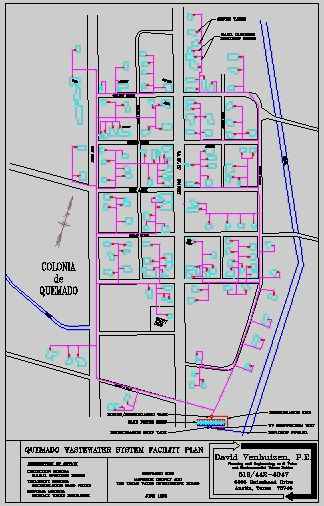
Colonia de Quemado Wastewater Facility Plan
This study was conducted under the Economically Distressed Area Program (EDAP) of the Texas Water Development Board (TWDB). The project provided plans for addressing the water and wastewater service needs of Quemado and surrounding areas. Quemado is an unincorporated community about 20 miles north of Eagle Pass in Maverick County. The county, which sponsored the study, contracted with Hejl, Lee & Associates (HLA), who in turn contracted with David Venhuizen, P.E., to execute the wastewater planning portion of the study.
While the water portion of the study covers a broader area, Venhuizen was directed to analyze alternatives for wastewater service only in the colonia of Quemado and to produce a facility plan document presenting the findings. Base maps, demographic information and a building count were provided by HLA. Using this information, Venhuizen generated demand models for both centralized and decentralized management strategies. He discussed the environmental and public health issues constraining wastewater service options. This included consideration of area soils, the physical layout of Quemado, and the likelihood and consequences of system failures, including pollution of the shallow aquifer which presently serves as the area's potable water supply. He then outlined and discussed advantages and disadvantages of the following generic management strategies:
- current practice, employing conventional septic tank/soil absorption field systems, contained within the confines of each fee simple lot;
- "improved" on-site systems, including enhanced pretreatment in sand filters or gravel marshes and dispersal in shallow, pressure-dosed drainfields or subsurface drip irrigation fields, again with all facilities contained within the confines of each fee simple lot;
- small-scale collective treatment centers, utilizing the STED (septic tank effluent drain) sewer concept to route flow from each lot to the treatment center, and providing high quality treatment in sand filters or gravel marshes (constructed wetlands), with the effluent routed back to the lots generating the flow for reuse in subsurface drip irrigation fields or in shallow, pressure-dosed drainfields ("pseudo-drip" fields);
- small-scale collective treatment centers, again employing STED sewers and sand filters or gravel marshes, with effluent routed off-site, to either irrigation reuse or surface discharge;
- a small-diameter sewer system-using the STED concept or the STEP (septic tank effluent pump) concept, as dictated by topography-routing effluent from septic tanks on each lot to a centralized treatment plant, employing either conventional treatment technologies or alternative technologies like sand filters or constructed wetlands; and
- a conventional sewer system, again with the option of either conventional or alternative treatment works at one centralized plant.
To clarify the basis of cost estimates-especially for "non-standard" system components-Venhuizen detailed system component service life and design sizing assumptions. The former were required to obtain a net present worth, which would be different than capital cost for facilities which would require replacement or upgrades before the end of the 20-year planning horizon and for facilities with a service life longer than 20 years. Venhuizen employed his extensive knowledge of alternative technologies to determine both service life and appropriate design parameters.
Upon the basis of all these analyses, Venhuizen generated 15 specific alternatives and produced detailed cost estimates for each. Each system plan was laid out to scale on base maps of Quemado in order to derive accurate estimates of quantities. The options for service included:
- conventional septic tank/soil absorption on-site systems;
- low pressure-dosed on-site systems;
- sand filter/drip irrigation on-site systems;
- gravel marsh (constructed wetland) on-site systems;
- small-scale collective sand filter systems with on-lot reuse;
- small-scale collective gravel marsh systems with on-lot reuse;
- small-scale collective sand filter systems with off-lot reuse or discharge;
- small-scale collective gravel marsh systems with off-lot reuse or discharge;
- centralized sand filter system with STED collection system;
- centralized gravel marsh system with STED collection system;
- centralized activated sludge package plant with STED collection system;
- centralized sand filter system with conventional collection system;
- centralized gravel marsh system with conventional collection system;
- centralized activated sludge package plant with conventional collection system; and
- centralized lagoon system with conventional collection system.
The options were ranked in order of net present worth of construction costs. The cost criterion chosen was net present worth per building served. Results of the cost analysis showed, not surprisingly, that conventional septic tank systems would be the lowest cost option, with an estimated net present worth of $3,219 per building. This was followed closely by a centralized sand filter plant with a STED collection system, having an estimated net present worth of $3,234 per building. This option is shown in the figure below, which also provides an idea of the nature of this community. The next lowest option was small-scale collective sand filter systems with off-lot reuse or discharge, at $3,685 per building. The other options ranged upward from there. Net present worth of conventional, centralized sewerage and a lagoon or package plant was in the range of $5,800 per building, about 1.8 times the options with the lowest net present worth.
Estimates of net present worth of 20 year's of O&M expenses were also generated for each option. Assumptions about maintenance costs were laid out to assist in evaluation of the estimates. Again, the conventional septic tank system ranked lowest, with an estimated net present worth of $739 per building, which works out to an equivalent cost of $6.25 per month. This estimate is, however, quite sensitive to assumptions about the level of oversight required to assure that system failures-including percolation of inadequately treated effluent to groundwater-are detected and corrected in a timely manner. And again the centralized sand filter system with a STED collection system exhibited the second lowest net present worth, at $1,453 per building, which works out to $12.16 per month. The package plant options exhibited the highest O&M present worth, at over $4,000 per building, which is an equivalent cost of about $35 per month.
The report concluded with a discussion of the results. Based upon the cost analyses, the community appeared to have two choices: (1) continue using conventional on-site systems, with appropriate safeguards against environmental and public health hazards, or (2) install a centralized system employing alternative sewers and treatment works, incurring a higher O&M cost but eliminating those environmental and public health hazards. Several factors, relating to the ability of each lot to accommodate a code-compliant on-site system, to management issues, and to regulatory uncertainties were pointed out. Due to the problems and uncertainties of proceeding with a conventional on-site management scheme, Venhuizen recommended implementing the collective system, but a final conclusion on which of these courses to pursue rests upon a resolution of the issues he has noted.
After this facility plan was presented to the TWDB in 1993, it was put on a list for 100% funding as a demonstration project. However, Maverick County subsequently became involved in legal problems-unrelated to this project-with the TWDB, and the project has been inactive since that time.